Download:
- Paper (arXiv:2611.21353), submitted to the Journal of Computational Physics
- Scripts and data of every figure
- Honghu.jl, the code where the algorithm is implemented (v0.1.0, doi:10.5281/zenodo.23569082)
In brief:
Radiation-hydrodynamics codes that transport radiation explicitly must take time steps short enough for light to cross only one cell per step. The standard remedy in the literature, the reduced speed of light approximation (RSLA; Gnedin & Abel 2001), used in most explicit codes today, makes this affordable by replacing the speed of light $c$ with a smaller $\hat{c} = \phi_0 c$. It works in transparent gas, but fails in optically thick gas: it inflates the heat capacity of the radiation by $1/\phi_0$, so temperature structures diffuse too slowly and fall behind the flow that carries them.
Our new method, the Adaptive Reduced Speed of Light Approximation (ARSA), replaces the single factor $\phi_0$ with a reduction factor $\phi$ chosen cell by cell. A von Neumann stability analysis of the implicit-explicit update used by modern two-moment codes gives, in closed form, the largest $\phi$ that each cell can use stably at the time step of the RSLA. In opaque cells the exchange of energy with the gas damps the unstable modes, so these cells can use $\phi = 1$, the true speed of light, while transparent cells keep $\phi_0$. The limiter is local and has no tunable parameters.
An advected radiation pulse shows the gain (first figure below). At $\phi_0 = 0.01$, the standard RSLA lets the pulse fall 13 pulse widths behind the flow, while our ARSA, which runs at $\phi = 1$ in every cell, stays within $0.04$ widths of the exact solution. The ARSA thus reaches the accuracy of the unmodified equations at a time step 100 times larger: an effective speedup of 100.
The second figure shows where this works. The ARSA restores the unmodified equations in optically thick cells, provided that the gas holds most of the heat capacity, $\hat{h} < \phi_0$ (amber region). In transparent cells it reduces to the RSLA, so it is never worse. Where the radiation holds much of the heat (red region), as in massive-star envelopes or AGN tori, no affordable $\phi_0$ lets a cell reach $\phi = 1$, and the gain is small.
An advected radiation pulse
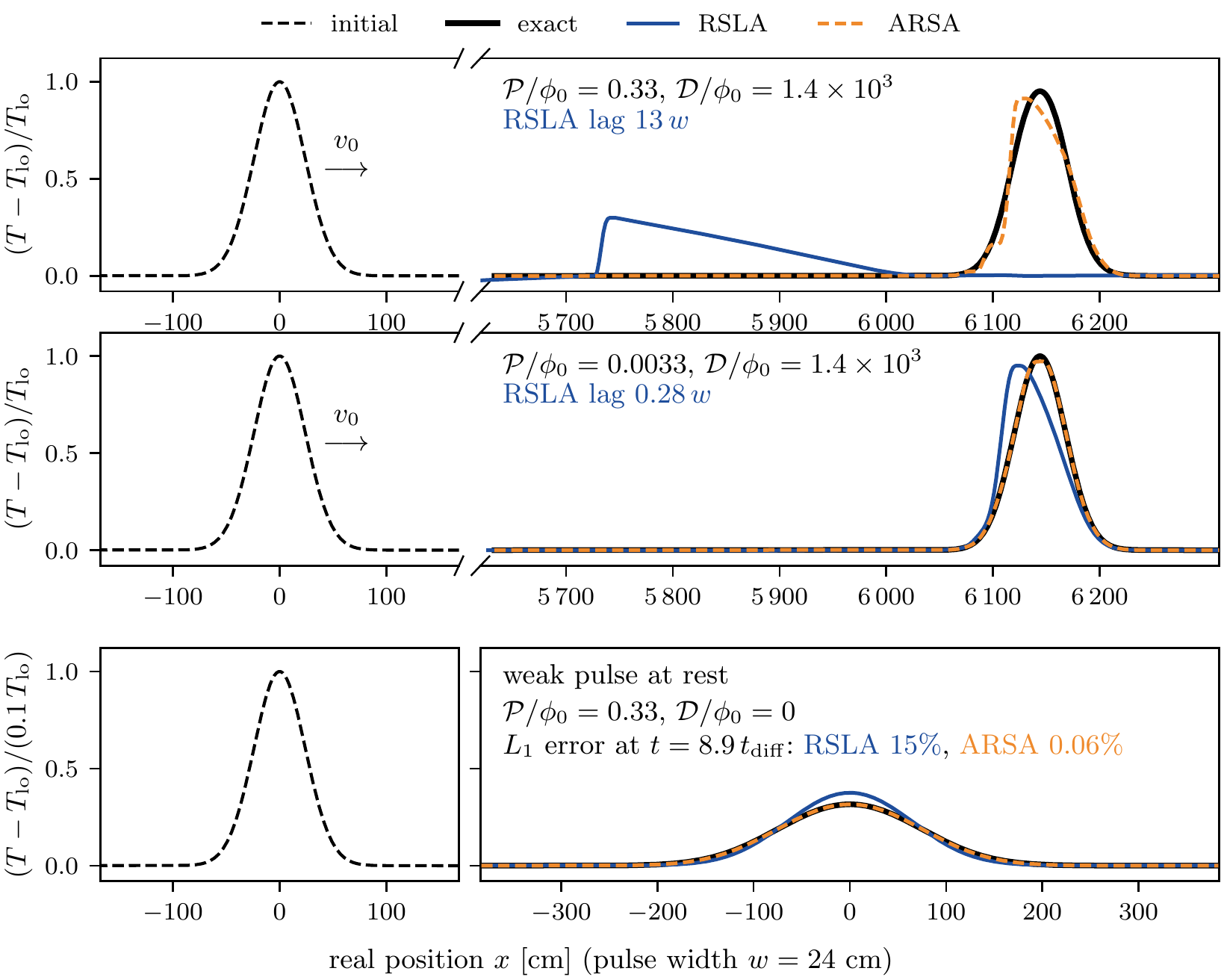
A temperature pulse carried by an optically thick flow. The standard RSLA (blue) lets the pulse fall behind the flow and diffuses it too slowly; our ARSA (orange) follows the exact solution (black) at the same time step.
Where the standard RSLA works, and where our ARSA fixes it
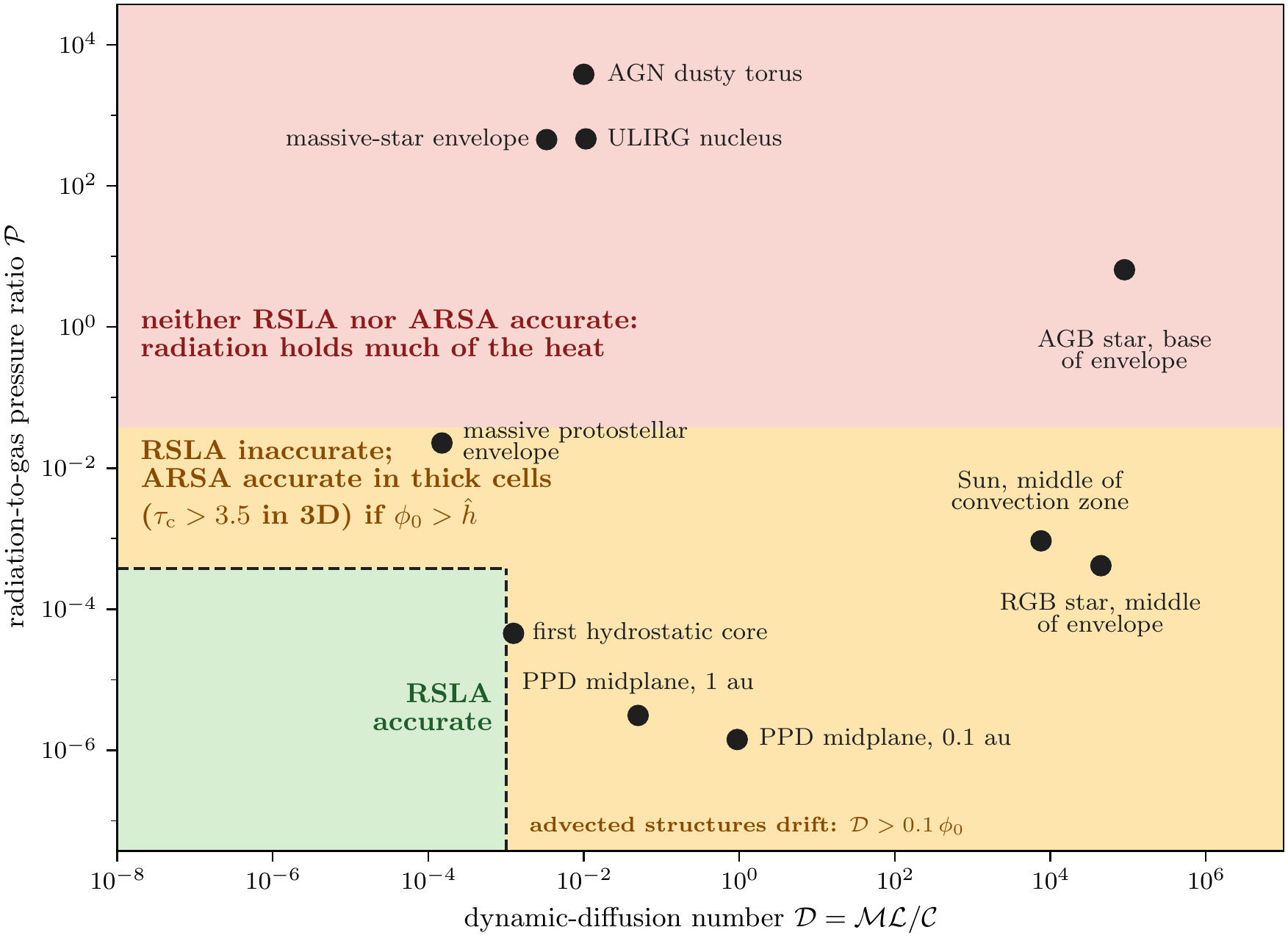
Optically thick astrophysical systems in the plane of the dynamic diffusion number $\mathcal{D}$ and the radiation-to-gas pressure ratio $\mathcal{P}$, for $\hat{c} = 0.01,c$. The standard RSLA is accurate only in the green corner. In the amber region our ARSA recovers the unmodified equations in optically thick cells at the time step of the RSLA.
Citation
He, C.-C., Krumholz, M. R., & Wibking, B. D. 2026, “An Adaptive Reduced Speed of Light Approximation”, submitted to the Journal of Computational Physics, arXiv:2611.21353.
@article{He2026ARSA,
author = {He, Chong-Chong and Krumholz, Mark R. and Wibking, Benjamin D.},
title = {An Adaptive Reduced Speed of Light Approximation},
journal = {arXiv e-prints},
eprint = {2611.21353},
archivePrefix = {arXiv},
year = {2026}}