Anisotropy of X-ray Bursts and accretion disk geometry
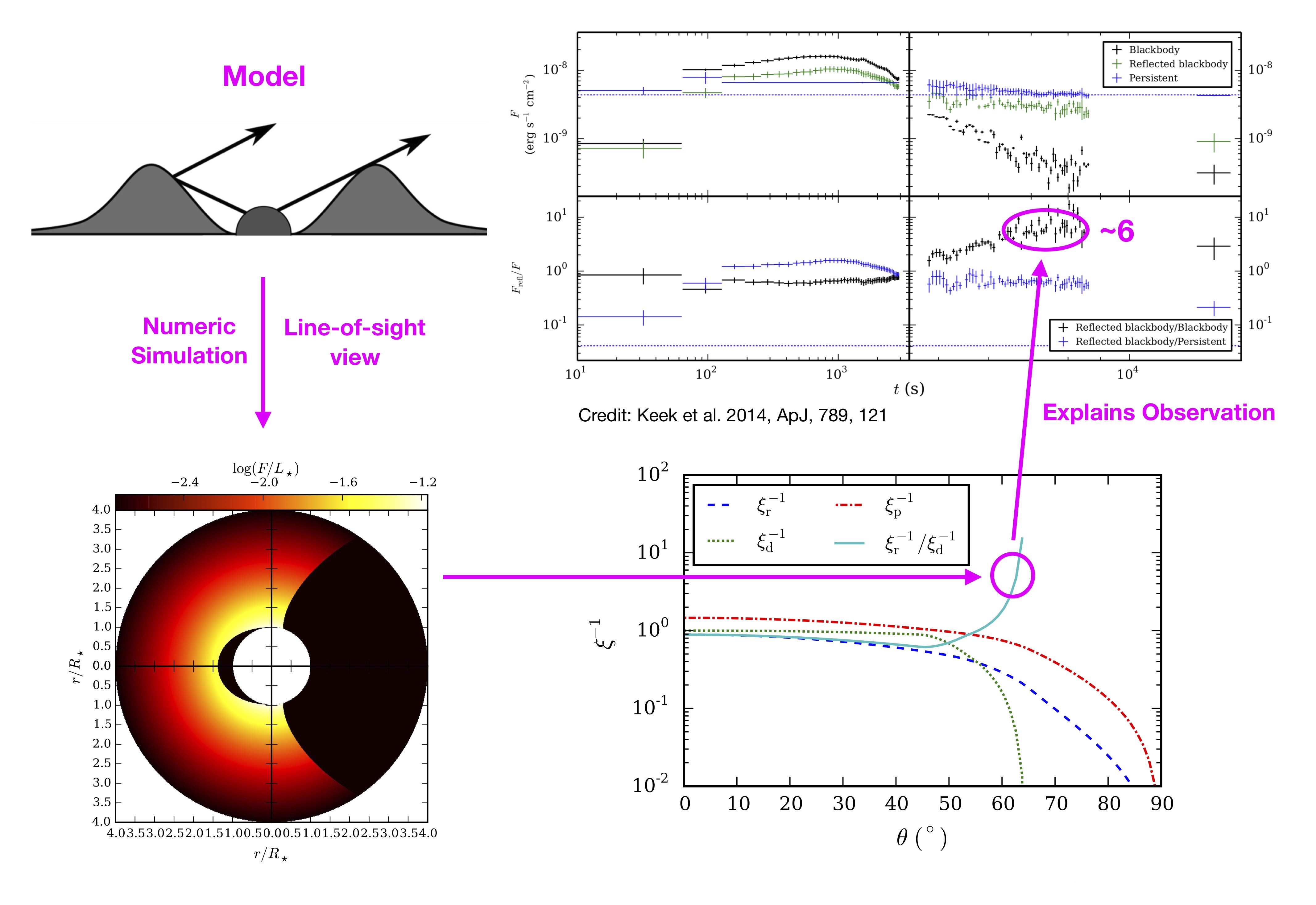
Summary The emission from neutron stars and accretion disks in low-mass X-ray binaries is not isotropic. Previous predictions of the anisotropy factors for burst flux assumed a flat disk. However, recent observations showed that the reflection fraction can reach ~6 at the tail of a superburst, which is much higher than what a flat disk can account for. To investigate this discrepancy, I created numerical models to calculate the anisotropy factors for different disk shapes (He & Keek, 2016). One model includes a disk with a thick bulge in the inner region. The anisotropy factors of the direct and reflected burst flux, as well as the anisotropy of the persistent flux, are presented. The results show that reflection fractions larger than unity are produced when the inner accretion disk steeply increases in height, blocking part of the star from view. This geometry could be induced by the X-ray burst if X-ray heating causes the inner disk to puff up. These findings suggest that the anisotropy of radiation in low-mass X-ray binaries is strongly influenced by the shape and height of the inner accretion disk. ...