About News Software Research Publications Teaching Blogs Contact Back to Top

About Me

I am an ARC Laureate Postdoctoral Fellow at the Research School of Astronomy & Astrophysics of the Australian National University, working with Professor Mark Krumholz. My research focuses on exploring the laws of star formation in galaxies, and how stellar feedback drives galactic winds, through simulations on supercomputers. I am a core developer of Quokka, a next-generation radiation-hydrodynamic code that fully utilizes the power of GPUs on the largest supercomputers in the world.

Research interests: star formation, stellar feedback, galactic outflows, radiation (magneto)hydrodynamics, numerical methods, and GPU computing.

Before joining ANU in 2023, I obtained my PhD degree in Astronomy from the University of Maryland, where I was advised by Massimo Ricotti and worked as a Future Investigator in NASA Earth and Space Science and Technology. I hold a B.S. in Physics from Jilin University in China. To learn more about my research, please visit the Research section.

Outside of my academic pursuits, I take pleasure in activities such as hiking, running, traveling, appreciating classical music, embarking on road trips, bicycling, watching movies, and coding for fun.
News

📣 March 2026: My new paper on GPU-accelerated particle method in Quokka was published on The Open Journal of Astrophysics

📣 August 2023: I joined the Australian National University as a Postdoctoral Fellow at the Research School of Astronomy & Astrophysics and work with Professor Mark Krumholz

📣 April 2023: I defended my Ph.D. thesis in April, 2023

📣 June 2021: I am awarded the Future Investigators in NASA Earth and Space Science and Technology (FINESST)!

📣 March 2021: I am awarded an Ann G. Wylie Dissertation Fellowship!

View All

Software

I develop open-source tools for computational astrophysics.

  • Quokka (core developer, C++): a GPU-accelerated, adaptive-mesh-refinement code for two-moment radiation hydrodynamics, with self-gravity, particles, chemistry, and magnetic fields.
  • Honghu.jl (author, Julia): a three-dimensional radiation-hydrodynamics code in pure Julia, built for comparing numerical schemes.

More about my software →

Research

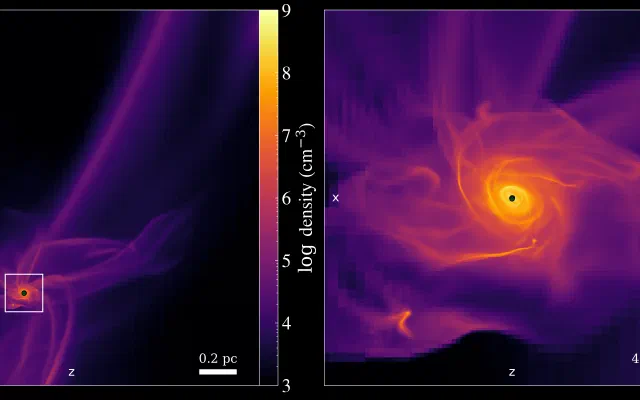
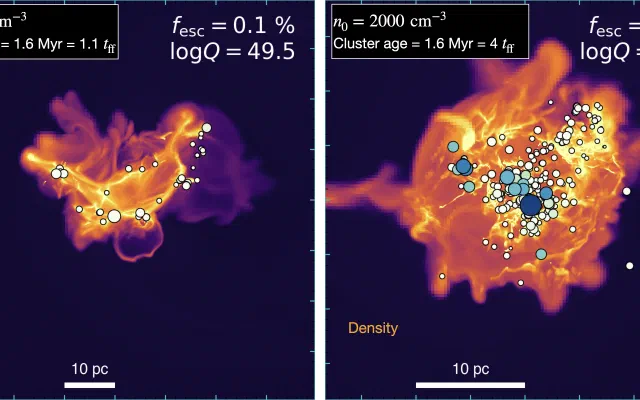
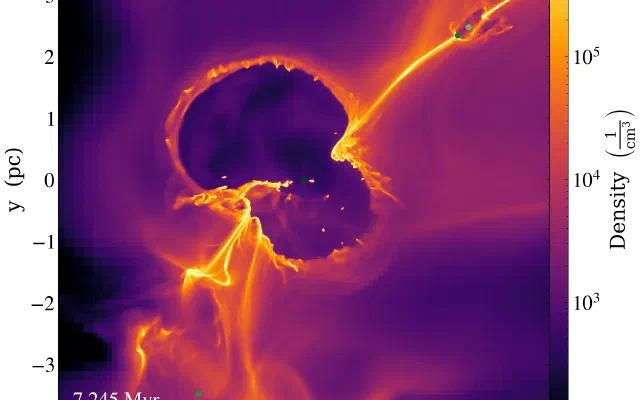
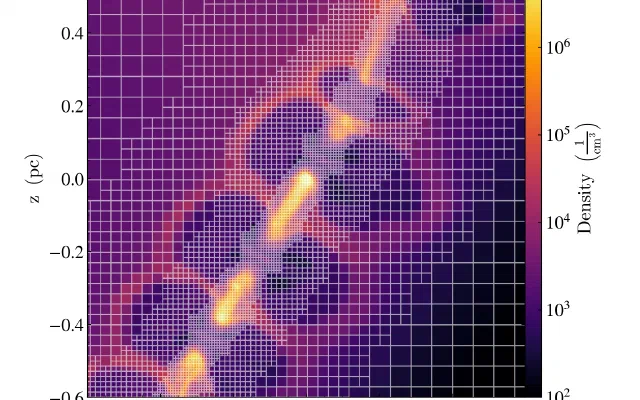
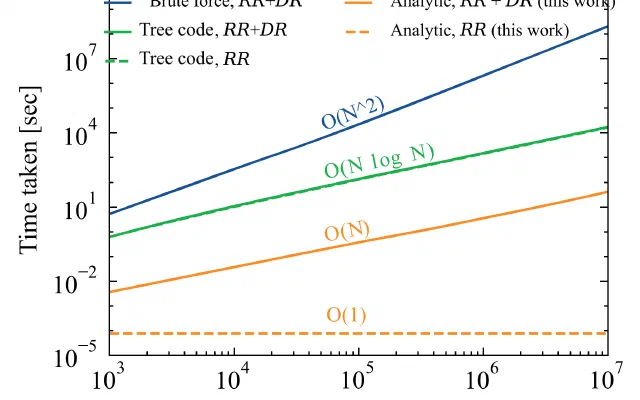
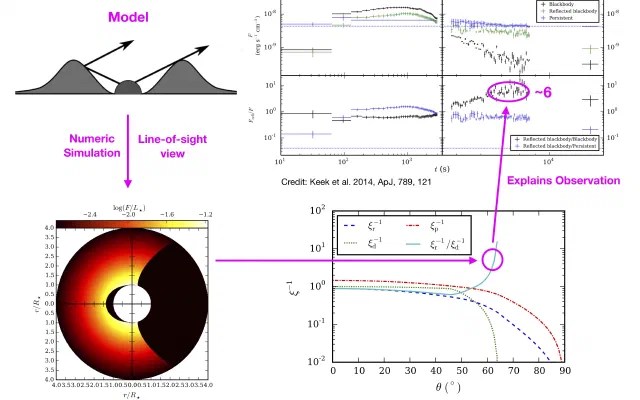
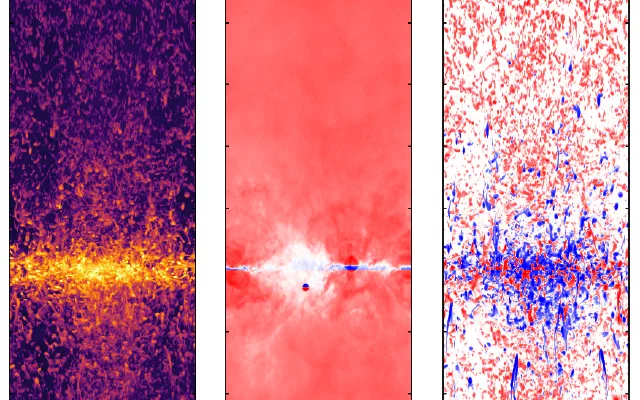
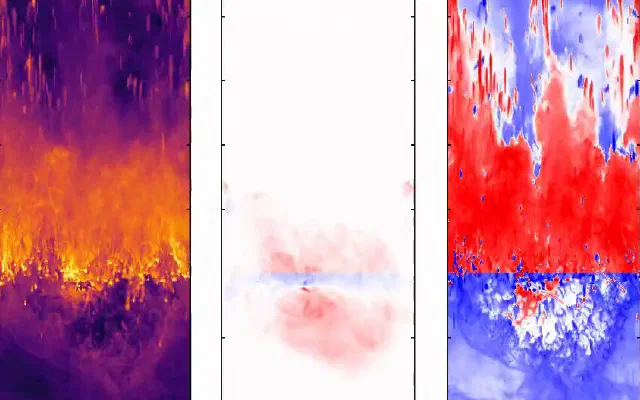
Outflow loading and phase structureSupernova-driven galactic outflows in tall-box Quokka simulations: how their loading and hot and cool phases depend on gas surface density, resolution, and metallicity. Development of Next-generation AMR Radiation Hydrodynamics Code on GPUsBuilding Quokka, a GPU-accelerated AMR radiation-hydrodynamics code: multigroup radiation, an asymptotically correct radiation-matter coupling, and a GPU-optimized particle framework. Massive Magnetically-critical Prestellar Cores and Formation of Large Turbulent Circumstellar DisksZoom-in radiation-MHD simulations of massive prestellar cores at about 10 AU resolution: fragmentation modes, large turbulent disks, and efficient conversion of gas into massive stars. Escape of Lyman Continuum Photons from Resolved Stellar PopulationsHow many ionizing photons escape molecular clouds: the escape fraction rises with cloud density and falls with cloud mass, which points to compact star clusters as the sources of reionization. Understanding Photoionization Feedback in Star Formation from Resolved SimulationsPhotoionization feedback disperses molecular clouds before the first supernovae, and the star formation timescale scales with the crossing time of the HII fronts. RAMSES-RTRAMSES-RT, the adaptive-mesh-refinement radiation-MHD code behind most of my star formation simulations. Analytic Two-point Correlation FunctionAn analytic method for galaxy two-point correlation functions: exact for simple survey shapes and 3-6 orders of magnitude faster than Monte Carlo pair counts. Anisotropy of X-ray Bursts and accretion disk geometryNumerical models of how a concave accretion disk shapes the anisotropy of X-ray burst emission from neutron stars.

All research projects →

Publications

First-author refereed publications. Co-authored papers and preprints are on the full publication list, and everything is on ADS and Google Scholar.

  • 9 C.-C. He, B. D. Wibking, A. Vijayan, M. R. Krumholz, & P. S. Li, 2026, “A novel algorithm for GPU-accelerated particle-mesh interactions implemented in the QUOKKA code”, The Open Journal of Astrophysics, 9, 159235.
    PDF | ads | DOI

  • 8 C.-C. He & M. Ricotti, 2025, “Formation of large circumstellar discs in multiscale, ideal-MHD simulations of magnetically critical, massive pre-stellar cores”, Monthly Notices of the Royal Astronomical Society, 540, 175.
    PDF | ads | DOI

  • 7 C.-C. He, B. D. Wibking, & M. R. Krumholz, 2024, “A novel numerical method for mixed-frame multigroup radiation-hydrodynamics with GPU acceleration implemented in the QUOKKA code”, Monthly Notices of the Royal Astronomical Society, 535, 3059.
    PDF | ads | DOI

  • 6 C.-C. He, B. D. Wibking, & M. R. Krumholz, 2024, “An asymptotically correct implicit-explicit time integration scheme for finite volume radiation-hydrodynamics”, Monthly Notices of the Royal Astronomical Society, 531, 1228.
    PDF | ads | DOI

  • 5 C.-C. He & M. Ricotti, 2023, “Massive pre-stellar cores in radiation-magneto-turbulent simulations of molecular clouds”, Monthly Notices of the Royal Astronomical Society, 522, 5374.
    PDF | ads | DOI

  • 4 C.-C. He, 2021, “A Fast and Accurate Analytic Method of Calculating Galaxy Two-point Correlation Functions”, The Astrophysical Journal, 921, 59.
    PDF | ads | DOI

  • 3 C.-C. He, M. Ricotti, & S. Geen, 2020, “Simulating star clusters across cosmic time - II. Escape fraction of ionizing photons from molecular clouds”, Monthly Notices of the Royal Astronomical Society, 492, 4858.
    PDF | ads | DOI

  • 2 C.-C. He, M. Ricotti, & S. Geen, 2019, “Simulating star clusters across cosmic time - I. Initial mass function, star formation rates, and efficiencies”, Monthly Notices of the Royal Astronomical Society, 489, 1880.
    PDF | ads | DOI

  • 1 C.-C. He & L. Keek, 2016, “Anisotropy of X-Ray Bursts from Neutron Stars with Concave Accretion Disks”, The Astrophysical Journal, 819, 47.
    PDF | ads | DOI

Full publication list →